

Degrader
Integrating Degradation, Engagement, and Selectivity: CETSA® as a Framework for Degrader Validation
Validate your PROTAC from mechanism to selectivity – all in live cells.
Discover how CETSA® provides an integrated approach to degrader validation. This CDK9-targeted degrader case study demonstrates how CETSA delivers the complete picture, from confirming target loss to revealing off-target effects.
What you’ll learn:
Degrade first: Measure what matters
Quantify target degradation in live cells and primary human PBMCs with dose- and time-dependent readouts.
Confirm engagement inside live cells
Measure thermal stabilization to distinguish true target binding from non-productive interactions in intact cells.
Profile selectivity before it’s a problem
Reveal the full degrader impact: on-target degradation, neo-substrate effects, and downstream pathway modulation that conventional assays miss.
A workflow that scales from screening to clinic
The case study demonstrates how CETSA supports degrader development from early validation through translational studies in patient-derived cells.

Why CETSA for degrader research?
- Physiologically relevant – intact, unmodified cells
- Native proteins – no tagging required
- Quantitative – kinetic readouts
- Comprehensive – degradation, engagement, and selectivity in one workflow
- Translational – applicable to patient PBMCs
Whether you’re validating a lead degrader or profiling selectivity for IND-enabling studies, this poster illustrates how CETSA provides the integrated data you need to move forward with confidence.
Download now to see the complete CDK9 degrader dataset and learn how CETSA can strengthen your PROTAC development program.
You might also be interested in
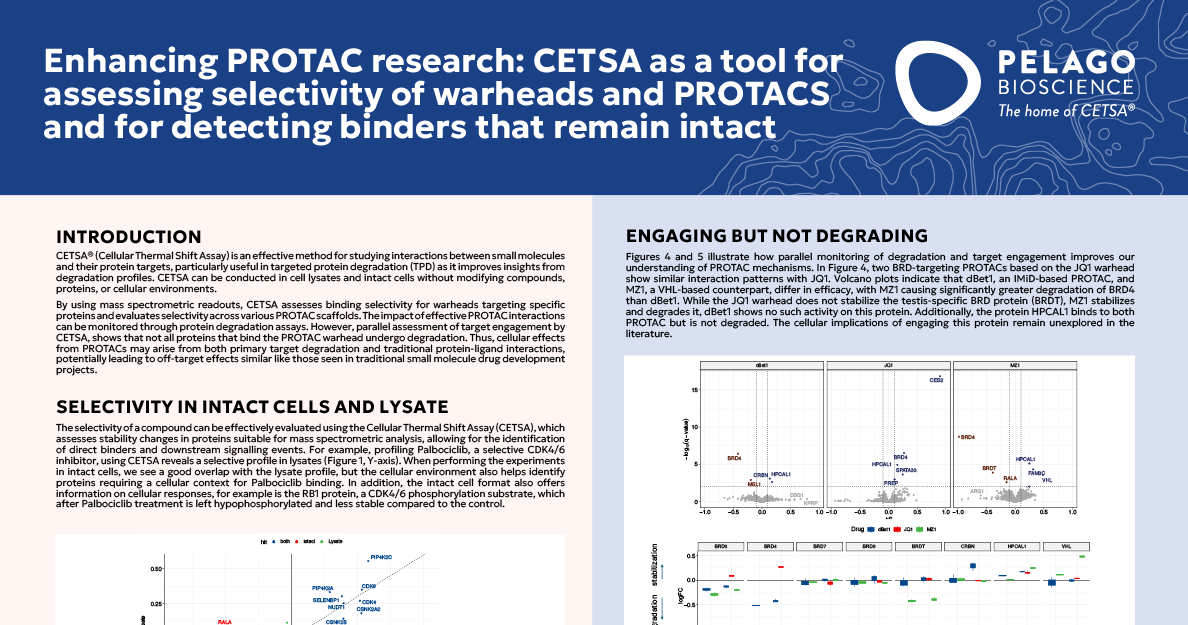
CETSA as a tool for assessing selectivity of warheads and PROTACS and for detecting binders that remain intact
CETSA® (Cellular Thermal Shift Assay) is an effective method for studying interactions between …

No Target, No Therapy – Target Engagement with CETSA®
Direct Insights into Target Engagement with CETSA® Discover how potency ranking with CETSA help…

Right tools, right time:
Boost your drug discovery success by adopting proteome-wide CETSA® profiling earlier  …