

From Signal to Certainty: A Management Playbook for Degrader Programs
From Signal to Certainty: A Management Playbook for Degrader Programs
The solution is faster and better than you may think!
Early degrader decisions often lean on tagged constructs and non-physiological systems and teams carry forward chemistry that … fails at a later stage. Many degrader programs are asked to commit resources before the biology is proven in cellular reality. The consequences mean that time slips, spending accumulates, and risk concentrates in late development stages. For leadership teams, this is a governance challenge as much as a scientific one.
CETSA changes the footing. It directly measures target engagement and the downstream consequences in intact, untagged cells under native conditions. Those insights are then paired with selectivity data generated in the same cellular context. The result is practical: you advance compounds that work in cells, not only in engineered systems, and you terminate non-viable leads early. Your GO/NO‑GO discussions become decisive because the evidence is produced where the drug actually has to function.
One common detour is tag‑driven distortion. When early assays depend on engineered tags, conformational drift can produce “wins” that do not translate into live systems. CETSA removes the labelling from the equation and measures the thermodynamic shift in the cells themselves, allowing your teams to focus on signals that translate.
Another trap is the gap between binding and degradation. A series that binds a target may still fail to deliver the intended outcome. By harmonising engagement and degradation readouts in one cellular context, and using proteasome‑blocker controls to confirm mechanism, you can see early whether a binder behaves as a degrader. Chemistry discovered with CETSA usually translates to real-life cell biology.
Exposure adds a third source of delay. Heterobifunctional degraders can appear “active” at high concentrations while starving the productive ternary complex. CETSA maps the productive window early, distinguishing the zone that truly drives degradation from high‑dose plateaus that mislead. That clarity supports dose planning and toxicology design before plans harden.
Selectivity is the fourth pressure point, and the costliest if discovered late. Proteome‑wide CETSA profiling surveys off‑targets in parallel and early enough for you to adjust chemistry and study design while it still counts. Phenotypes are less likely to be misread, and portfolio triage becomes faster and cleaner.
What this means to your company
First, decision‑grade evidence in native systems: engagement, consequence, exposure, and selectivity arrive as a single line of evidence grounded in cells. Governance can then shift from debating model assumptions to weighing actual mechanisms. Second, shorter cycles with fewer detours, because linked readouts in one context compress iteration without sacrificing caution. Third, you can spend your money as you follow the evidence! Your budgets can be released against data with clearer clinical realism. This is particularly true once the exposure window is defined and the off‑target picture is understood.
Pelago’s execution is designed for leadership cadence. Targeted‑HT experiments read engagement and degradation in intact, living matrices. The workflow keeps engagement and consequence linked, promotes binders only when they behave as degraders, maps the productive exposure window early, and schedules proteome‑wide selectivity in time to matter. The intent is not to add steps, but to replace avoidable iteration with decision‑ready evidence.
The manager’s checklist for the next governance gate
- Cell‑based engagement and degradation in the same context, with a proteasome‑blocker control to confirm mechanism.
- An exposure–response map that distinguishes the productive degradation window from high‑dose artefacts.
- Proteome‑wide selectivity data that surfaces liabilities early enough to redirect chemistry.
- A GO/NO‑GO proposal in which spending and timelines are explicitly tied to evidence grounded in cellular realities.
If you are guiding a degrader program and need go or no-go decisions anchored in valid biological data, let’s see what we can achieve together. Pelago’s CETSA-based packages are designed to accelerate drug discovery, delivering clear answers based on true mechanisms. Our speed keeps your program moving. Our friendly Japan Manager Stefan Sandström, in Yokohama Landmark Tower and at Shonan iPark, will be happy to support you and connect you to Pelago’s subject matter experts.
We are looking forward to discussing your Degrader project.
You can read more about Degraders here!
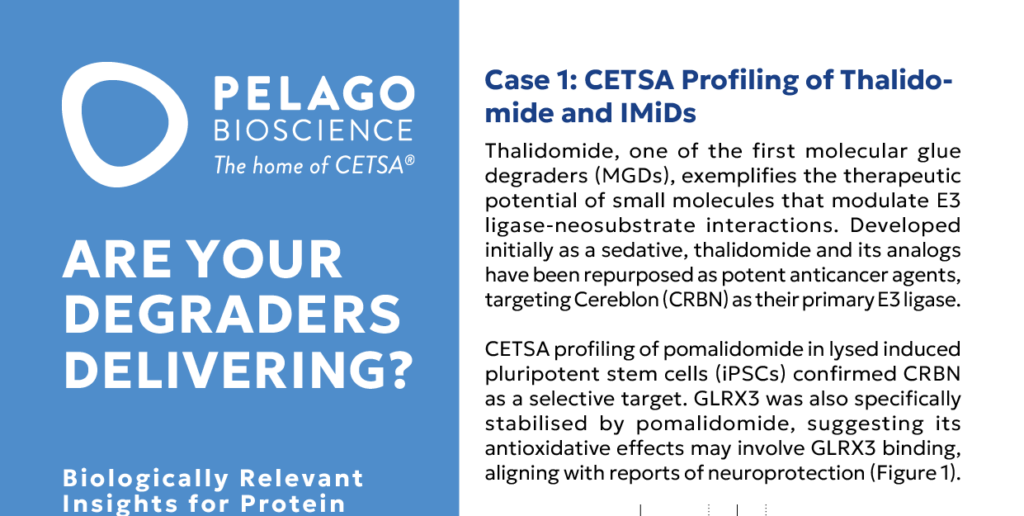
Protein Degradation – Are Your Degraders Delivering?
Uncover Mechanisms with CETSA® This application note explores how CETSA reveals target specificity and mechanisms of action, helping optimize degrader molecules for clinical success. Learn from …
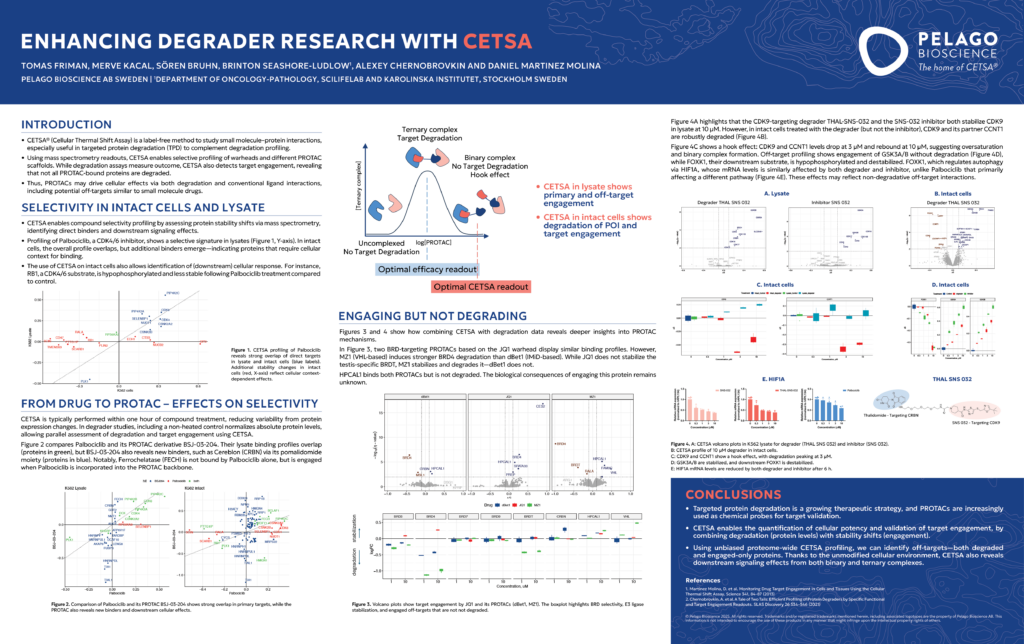
Targeted Protein Degradation – Enhancing Degrader Research with CETSA®
Unlocking New Insights into Targeted Protein Degradation with CETSA: Revealing Both Target Engagement and Off-Target Effects In the rapidly evolving field of targeted protein degradation (TPD), unders…
Label-free validation of protein degraders using CETSA®
In this webinar, you will learn how Pelago Bioscience can support the early stages of hit identification and validation in a high throughput manner with CETSA® Navigate HT and how CETSA® Explore provi…